Wedding Dress Silhouettes by Body Shape: How to Find the Right Bridal Gown for You
Choosing a wedding dress is one of those decisions that looks simple from the outside and becomes considerably more complicated once you actually start shopping. There are ball gowns, A-line dresses, mermaid silhouettes, trumpet gowns, sheath dresses, fit-and-flare styles, empire waists and countless variations created by changing a neckline, adding sleeves, modifying the waistline or changing the way a skirt falls. Then there are fabrics, lace, satin, beading, trains and hundreds of other details competing for attention. It is easy to become overwhelmed by the number of choices.
One of the most common pieces of advice brides hear is to choose a wedding dress according to their body shape. While there is some value in understanding proportions and how different silhouettes interact with the body, it is important not to treat these recommendations as strict rules. There is no single wedding dress that is “correct” for a particular body type. The most flattering gown is often the one that makes the bride feel comfortable, confident and completely herself.
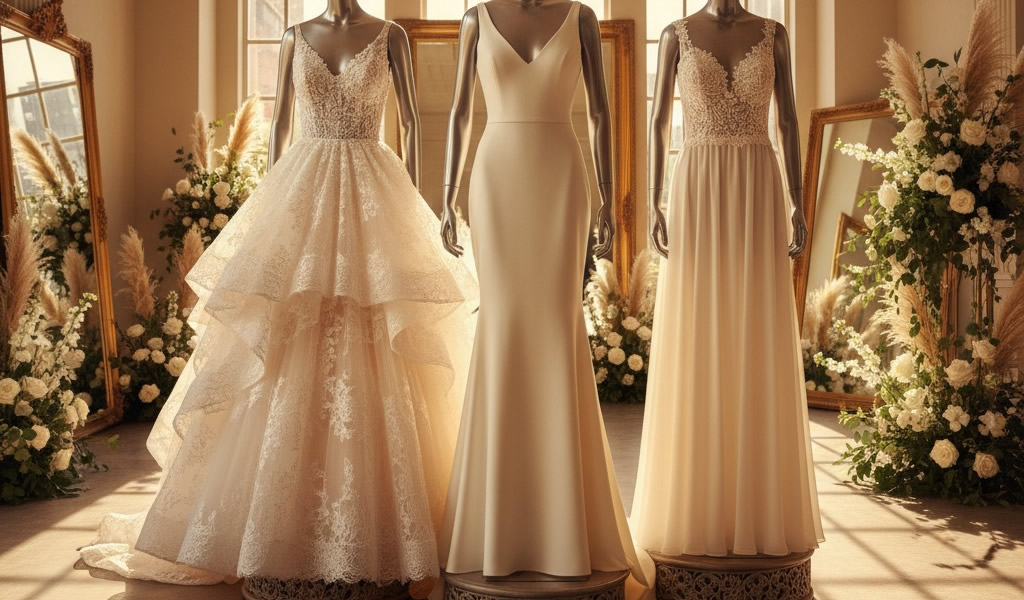
A silhouette is simply the overall shape created by the gown from the bodice through the skirt. It influences how the dress moves, how the proportions appear and how the gown photographs. Understanding the major silhouettes can make wedding dress shopping much easier because you begin to recognize not only what you like visually, but also how different constructions behave when you actually put them on.
The goal is not to find a dress that hides your body.
The goal is to find a dress that works with it.
Why Wedding Dress Silhouette Matters
Before thinking about lace, embellishments or even the neckline, it is useful to understand the silhouette. The silhouette establishes the fundamental architecture of the gown. Two dresses can have almost identical fabrics and decorative details but look completely different because one is A-line while the other is mermaid or sheath.This is why a bride who falls in love with a particular dress in a photograph may be surprised when she tries it on. The fabric might be beautiful, the neckline might be perfect and the details might be exactly what she imagined, but the proportions may not create the feeling she expected. Conversely, a dress that looked ordinary on a hanger can suddenly become extraordinary when it fits the body correctly.
The silhouette also affects movement. A fitted mermaid gown behaves very differently from a flowing A-line dress, while a dramatic ball gown creates an entirely different presence when walking into a ceremony. The right choice therefore depends not only on appearance but also on how you want to move and feel during one of the most important days of your life.
A-Line Wedding Dresses
The A-line wedding dress is one of the most versatile bridal silhouettes because it gradually expands from the waist toward the floor, creating the characteristic shape of the letter “A.” The bodice can be fitted or relatively relaxed, while the skirt provides movement without the amount of volume associated with a traditional ball gown.This silhouette has remained popular because it can adapt to an enormous range of wedding styles. An A-line gown in lightweight chiffon can feel effortless and romantic for an outdoor wedding, while an A-line gown in structured satin or mikado can look formal and architectural in a sophisticated ballroom.
From a proportion standpoint, the gradual expansion of the skirt can create a balanced visual line without requiring the bride to conform to a particular body type. This is one reason A-line gowns are frequently recommended as an excellent starting point for brides who are still exploring their options.
But there is an even more important reason to try one: it may simply make you feel like yourself.
Ball Gown Wedding Dresses
Few silhouettes create as much drama as the ball gown. A fitted bodice combined with a voluminous skirt produces the traditional fairytale effect that many brides have imagined since childhood.The ball gown is particularly powerful in formal settings because it takes up visual space. In a large church, historic venue or elegant ballroom, that volume can feel completely natural. The architecture of the dress and the architecture of the venue begin to work together.That does not mean petite brides or brides with fuller figures should automatically avoid ball gowns. The proportions of the skirt, the position of the waistline, the fabric and the amount of volume can all be modified. A very structured, enormous skirt creates a different effect from a softer ball gown with lighter layers.
This is where trying on different versions of the same silhouette becomes important. The label “ball gown” tells you the general shape, but it does not tell you exactly how that particular dress will look on your body.
Mermaid Wedding Dresses
The mermaid silhouette is designed to follow the body closely through the bodice, waist and hips before dramatically widening toward the lower portion of the skirt. It is one of the most body-conscious bridal silhouettes and creates a distinctly glamorous appearance.Because the gown follows the body’s contours, fit becomes especially important. Small differences in the placement of seams, the construction of the bodice and the position where the skirt begins to flare can significantly change the appearance of the dress.A mermaid gown can look spectacular when it is properly fitted, but the bride also needs to consider movement. Walking, sitting, dancing and navigating stairs can require more attention in a very fitted gown than in an A-line or sheath silhouette.
For some brides, that structured feeling is exactly what they want. For others, the freedom of a softer skirt will make the wedding day more enjoyable.
There is no right answer.
There is only the answer that makes sense for you.
Trumpet Wedding Dresses
Trumpet gowns are related to mermaid silhouettes but generally begin to flare somewhat higher on the body, creating a different visual transition between the fitted portion and the skirt.That distinction may seem subtle when looking at photographs, but it can be noticeable when wearing the dress.A trumpet silhouette can provide the dramatic effect of a fitted gown while offering slightly more movement through the lower skirt. For brides who like the idea of a mermaid dress but are concerned about feeling restricted, trying a trumpet silhouette can be worthwhile.
Again, the exact construction matters more than the name.
Different designers interpret these silhouettes differently, so it is always better to evaluate the actual gown rather than relying exclusively on terminology.
Fit-and-Flare Wedding Dresses
Fit-and-flare gowns provide another interpretation of the fitted bridal silhouette. Instead of maintaining a close fit until the knee and then dramatically opening like some mermaid designs, the skirt can begin to expand more gradually.
This creates a softer transition and can make the gown easier to move in.
For brides who want to highlight their natural proportions but do not want the dramatic structure of a traditional mermaid gown, fit-and-flare can be an excellent middle ground.
It also works across a wide range of wedding aesthetics. Depending on the fabric and details, the same basic silhouette can feel romantic, modern, glamorous or minimalist.
Sheath and Column Wedding Dresses
Sheath and column gowns create a long, relatively narrow vertical line through the body. They are particularly popular with brides who prefer contemporary, understated or minimalist bridal fashion.Instead of relying on volume, these gowns emphasize the fabric, construction and natural movement of the body.
A silk or satin column dress can feel incredibly luxurious precisely because there is very little competing for attention. The simplicity puts more emphasis on the quality of the fabric, the neckline, the fit and the bride herself.
These gowns can be particularly beautiful for destination weddings, city weddings and modern venues, although there is no reason they cannot work in a traditional setting.
Empire Waist Wedding Dresses
An empire waist places the seam or visual waistline above the natural waist, generally closer to the ribcage, allowing the skirt to fall more freely from that point.This creates a very different proportion from an A-line or mermaid gown.Empire silhouettes can feel romantic, relaxed and distinctly feminine. They can also be particularly comfortable for brides who prefer less structure around the waist and hips.The effect depends heavily on fabric. Lightweight materials can create an almost ethereal appearance, while more structured fabrics can make the silhouette feel more architectural.
The Importance of Proportion
When brides talk about finding a dress that “flatters” them, they are often really talking about proportion.
The eye naturally responds to relationships between different parts of the garment: where the waist appears to sit, where the skirt begins to expand, how much volume exists at the bottom and how the neckline relates to the shoulders.This is why a small alteration can sometimes make a surprisingly large difference.
Moving a waistline slightly, adjusting the bodice, changing the hem or refining the fit around the hips can alter the overall visual balance of the gown.
The dress does not necessarily need to be replaced.
Sometimes it simply needs to be refined.
Wedding Dresses for a Pear-Shaped Figure
A pear-shaped figure is often described as having more visual volume through the hips and thighs than through the shoulders and bust.
Traditional bridal advice frequently suggests A-line or ball gown silhouettes because the skirts create a gradual or dramatic expansion from the waist rather than closely following the hips.
But there is no reason a bride with this proportion cannot wear a fitted gown.
A mermaid or fit-and-flare dress can look extraordinary when the bride wants to emphasize rather than minimize her curves.
The real question is what effect you want.
Do you want the gown to create a balanced, flowing line? An A-line may provide that feeling.
Do you want the silhouette to celebrate your curves? A fitted gown may be exactly right.
Wedding Dresses for an Hourglass Figure
An hourglass proportion generally features a relatively defined waist with a more balanced relationship between the bust and hips.
Many different silhouettes can work beautifully with this proportion because the waist can become an important visual anchor.
Mermaid, trumpet, fit-and-flare and A-line gowns can all produce different effects.
A fitted silhouette emphasizes the body’s natural curves, while an A-line creates a more traditional bridal shape.
The choice should therefore come down to personality and comfort rather than simply following a recommendation.
Wedding Dresses for an Apple-Shaped Figure
Apple-shaped proportions are often described as carrying more visual volume through the center of the body.
Brides with this proportion may enjoy gowns that create a longer vertical line or place emphasis elsewhere, such as through the neckline, shoulders or flowing skirt.
A-line and empire-waist gowns can be particularly interesting starting points, while structured bodices can provide support and definition when properly fitted.
But again, there is no need to interpret this as a rule about what a bride “should” wear.
If you love a fitted gown, the objective should be to determine how that gown can be constructed and altered so that it fits comfortably and beautifully.
Wedding Dresses for Petite Brides
Petite brides are sometimes told that they should avoid dramatic gowns because the volume can overwhelm their frame.
That advice is too simplistic.
A petite bride can absolutely wear a ball gown.
The important consideration is proportion.
A very large skirt combined with an excessively long train and a heavily decorated bodice may create a considerable amount of visual information. A more carefully proportioned ball gown can create exactly the opposite effect: an elegant, dramatic silhouette that feels intentional.
A-line, sheath and fit-and-flare silhouettes can also create strong vertical lines that many petite brides enjoy.
The best way to know is to see the dress on your body.
Wedding Dresses for Tall Brides
Tall brides often have the advantage of being able to carry dramatic silhouettes and long vertical lines particularly well.
A column gown can emphasize height beautifully, while a ball gown can create an impressive contrast between a fitted bodice and a voluminous skirt.
Long trains can also become an important design feature.
However, height does not automatically determine the best silhouette.
A tall bride who wants something intimate and relaxed may prefer a simple sheath or slip-style gown.
Again, the question is not what height “allows.”
It is what the bride wants to communicate.
Plus-Size Wedding Dress Silhouettes
Bridal fashion has increasingly moved toward more inclusive approaches to fit and design, and today’s brides have considerably more choices than the simplistic body-shape rules of the past.
Plus-size brides can wear virtually every major bridal silhouette, provided the gown is properly constructed and fitted.
A well-designed bodice can provide support without feeling restrictive. Strategic seam placement can improve the overall line of the gown, while appropriate fabrics can create structure or movement depending on the desired effect.
A bride should never feel that her only choices are dresses designed to hide her body.
A wedding gown should be designed to dress her body.
That distinction matters.
The Neckline Changes Everything
The silhouette is only one part of the equation.
The neckline can completely change how the upper portion of a wedding dress looks.
A sweetheart neckline creates a romantic curved line.
A V-neck can create a sense of length.
A bateau neckline can emphasize the collarbone and create a sophisticated horizontal line.
A high neckline can provide a more modest and structured appearance.
An off-the-shoulder neckline introduces a softer, romantic quality.
This is why choosing a silhouette should not be separated completely from the rest of the gown.
The dress is a system of interconnected proportions.
Sleeves and Bridal Proportions
Sleeves can also change the character of a wedding dress dramatically.
Long lace sleeves can make a simple gown feel romantic and traditional. Clean fitted sleeves can create a modern appearance. Off-the-shoulder sleeves can emphasize the neckline and shoulders, while detachable sleeves allow a bride to change the look between ceremony and reception.
The popularity of detachable bridal elements has also made wedding dresses more versatile. Modern brides increasingly have the option of changing the appearance of the gown without changing the entire dress.
This can be particularly useful when the wedding includes different environments or levels of formality throughout the day.
Fabric Can Change the Silhouette
Two dresses with exactly the same pattern can look completely different when made from different fabrics.
Satin and mikado can provide structure and create crisp architectural lines.
Chiffon can produce movement and softness.
Lace can introduce texture and romance.
Crepe can create a clean, fluid line.
Tulle can create volume without necessarily feeling heavy.
This is why it is not enough to say that you like an A-line dress.
You may love an A-line silhouette in one fabric and dislike it completely in another.
The interaction between construction and material is what creates the final result.
The Wedding Venue Should Influence Your Choice
Your venue does not determine your dress, but it can provide useful context.
A dramatic ball gown can feel completely natural in a grand ballroom.
A lightweight sheath or A-line gown may feel more comfortable at an outdoor ceremony.
A minimalist column gown can be extraordinary in a modern architectural venue.
A romantic lace gown may complement a garden or historic setting.
These are not rules.
They are simply ways to think about the relationship between the bride and her environment.
A wedding dress should feel appropriate to the setting without becoming a costume.
Think About How You Want to Feel
This may be more important than body shape.
Do you want to feel glamorous?
Romantic?
Modern?
Elegant?
Effortless?
Dramatic?
Classic?
Sexy?
The answer can help narrow the options much faster than trying to determine which body category you belong to.
A bride who wants to feel like a movie star may naturally gravitate toward a structured mermaid gown.
Someone who wants a romantic fairytale feeling may love a ball gown.
A bride who values simplicity may feel most herself in a column silhouette.
Someone who wants freedom and movement may prefer an A-line.
The dress should support the emotional experience you want to have.
Comfort Is Not Optional
A wedding dress can look extraordinary and still be the wrong dress if you cannot comfortably wear it for several hours.
Think about walking.
Sitting.
Dancing.
Using the restroom.
Getting into a vehicle.
Moving through the ceremony.
Standing for photographs.
These practical details matter.
A bride should not have to spend the entire reception adjusting her dress or worrying about whether she can move.
The best-fitting gown eventually becomes something you stop thinking about.
That is the goal.
Wedding Dress Alterations Can Transform the Fit
Even an expensive bridal gown may not fit perfectly directly from the designer or bridal salon.
This is normal.
Wedding dresses are generally created according to standard size ranges, while every bride has individual proportions.
Professional wedding dress alterations can refine the gown so that it follows the bride’s body much more precisely.
The alterations may involve adjusting the bodice, taking in or releasing seams, modifying straps, refining the waist, shortening the hem, adjusting the train or creating a bustle for the reception.
These details may seem small, but together they determine how the gown behaves on the body.
Why the Hemline Matters
The hem is one of the most important alterations because it determines how the bride walks and how the entire skirt appears.
A dress that is too long can cause the bride to step on the fabric, while one that is too short can change the intended proportions of the gown.
The ideal hem depends on the bride’s shoes, the silhouette, the venue and the desired amount of movement.
This is particularly important with wedding dresses that have trains.
The train needs to look intentional while still allowing the bride to move comfortably.
The Bustle for the Wedding Reception
A bustle allows the train of a wedding dress to be lifted or secured after the ceremony so that the bride can move more easily during the reception.
This is one of those details that brides sometimes discover late in the planning process.
It should not be.
The bustle needs to be designed according to the construction and weight of the gown, and the bride should practice using it before the wedding day.
A friend, family member or member of the bridal party should also know how it works.
A beautiful train is wonderful during the ceremony.
Being able to dance comfortably afterward is equally important.
Don’t Choose a Dress Only Because It Looks Good in Photos
Wedding dress photographs can be misleading.
Lighting, posing, camera angles and styling can make a particular silhouette look very different from how it appears in person.
This is why trying on different silhouettes remains so important.
You may discover that the dress you thought you wanted does not feel right, while another silhouette you never considered becomes the one you cannot stop thinking about.
Modern bridal guidance consistently recommends trying different silhouettes rather than making the decision entirely from photographs or preconceived rules.
Your body is three-dimensional.
The dress is three-dimensional.
The fitting room is where the real decision happens.
Bring an Open Mind to Your Bridal Appointment
It is perfectly reasonable to arrive at a bridal appointment with a clear idea of what you think you want.
Just leave some room for surprise.
A bride who has always imagined herself in a ball gown may discover that she feels incredibly elegant in a fitted crepe column dress.
Someone who has always wanted a mermaid gown may discover that an A-line allows her to move in exactly the way she wants.
The purpose of trying on different silhouettes is not to abandon your preferences.
It is to discover them more accurately.
There Is No “Perfect” Body for a Wedding Dress
The language surrounding body shape can sometimes make brides feel as though their bodies need to be corrected before they can wear certain styles.
That is the wrong approach.
Wedding dresses are garments created to be fitted and altered to individual bodies.
There is no requirement that a bride have a particular waist-to-hip ratio, height or proportion to wear a specific silhouette.
The dress should be adapted to the bride.
This is one of the reasons professional bridal alterations are so valuable. The goal is to refine the relationship between the garment and the person wearing it.
Finding the Right Silhouette for Your Personality
Ultimately, the most successful wedding dress is the one where the bride looks in the mirror and recognizes herself.
Not a model.
Not a celebrity.
Not a Pinterest board.
Herself.
The silhouette should support that identity.
A dramatic ball gown can communicate confidence and romance. A mermaid can feel glamorous and powerful. An A-line can feel timeless and effortless. A sheath can feel modern and sophisticated. A fit-and-flare can provide a balance between structure and movement.
None is inherently better than another.
They simply tell different stories.
Final Thoughts on Choosing a Wedding Dress Silhouette
Understanding wedding dress silhouettes can make the search for a bridal gown considerably easier, but body shape should be viewed as a starting point rather than a set of restrictions. A-line, ball gown, mermaid, trumpet, fit-and-flare, sheath, column and empire silhouettes can all work beautifully on different bodies when the construction, proportions and fit are right.
The most important question is not, “Which dress is supposed to look best on my body?”
A better question is, “Which dress makes me feel the way I want to feel on my wedding day?”
Once you know the answer, the rest becomes much easier.
You can choose the silhouette.
Then the neckline.
Then the fabric.
Then the details.
And finally, the alterations that bring everything together.
Because a wedding dress should not simply fit your measurements.
It should fit you.
And when the silhouette, fabric, proportions and alterations all work together, the result is more than a flattering wedding gown. It becomes the dress in which you remember exactly how you felt when you walked toward the person you were about to marry.